Wednesday, August 28, 2013

Child of the Kindertransport


Henry Foner was a child of the Kindertransport. A rescue missions to ensure the safety of thousands of Jewish children. The postcards below were sent from Foner's father, up until his deportation to Auschwitz, where he was murdered a week later.

Henry Foner, pictured as a young boy, has published the heartbreaking postcards sent by his father before he was killed at Auschwitz
                                 
                                    Henry Foner, the child recipient of his father's postcards. 

Max addressed the postcards to 'My dear little Henry!' and in this one says he hopes his son is 'well and happy'

In this poignant postcard sent shortly before Britain declared war on Germany, Max wrote to his son: 'I'm glad that you are well and happy. i hope war will not come.'

In the first cards, Max wrote to his son in German and called him by his birth name of Heini

In this card, Max wrote: 'I got your letter today and was very happy that you got the Easter eggs.

Links for further research:
1. Yad Vashem: http://www.yadvashem.org/
2. United States Holocaust Memorial Museum:  http://www.ushmm.org/
3. Jewish Virtual Library: http://www.jewishvirtuallibrary.org/

Thursday, August 1, 2013

Final Diary Entry of Anne Frank

On this day in history, Anne Frank wrote her final diary entry in which she expressed her hope for humanity and her belief that although there were individuals who committed the unspeakable, there was still a reason to hope and it is the goodness that still lived within society and within humans.

The final diary entry, written on August 1st, 1944:

"Dearest Kitty,
"A bundle of contradictions" was the end of my previous letter and is the beginning of this one. Can you please tell me exactly what "a bundle of contradictions" is? What does "contradiction" mean? Like so many words, it can be interpreted in two ways: a contradiction imposed from without and one imposed from within.
The former means not accepting other people's opinions, always knowing best, having the last word; in short, all those unpleasant traits for which I'm known. The latter, for which I'm not known, is my own secret.
As I've told you many times, I'm split in two. One side contains my exuberant cheerfulness, my flippancy, my joy in life and, above all, my ability to appreciate the lighter side of things. By that I mean not finding anything wrong with flirtations, a kiss, an embrace, an off-colour joke. This side of me is usually lying in wait to ambush the other one, which is much purer, deeper and finer. No one knows Anne's better side, and that's why most people can't stand me.
Oh, I can be an amusing clown for an afternoon, but after that everyone's had enough of me to last a month. Actually, I'm what a romantic movie is to a profound thinker – a mere diversion, a comic interlude, something that is soon forgotten: not bad, but not particularly good either.
I hate having to tell you this, but why shouldn't I admit it when I know it's true? My lighter, more superficial side will always steal a march on the deeper side and therefore always win. You can't imagine how often I've tried to push away this Anne, which is only half of what is known as Anne-to beat her down, hide her. But it doesn't work, and I know why.
I'm afraid that people who know me as I usually am will discover I have another side, a better and finer side. I'm afraid they'll mock me, think I'm ridiculous and sentimental and not take me seriously. I'm used to not being taken seriously, but only the "light-hearted" Anne is used to it and can put up with it; the "deeper" Anne is too weak. If I force the good Anne into the spotlight for even fifteen minutes, she shuts up like a clam the moment she's called upon to speak, and lets Anne number one do the talking. Before I realize it, she's disappeared.
So the nice Anne is never seen in company. She's never made a single appearance, though she almost always takes the stage when I'm alone. I know exactly how I'd like to be, how I am… on the inside. But unfortunately I'm only like that with myself. And perhaps that's why-no, I'm sure that's the reason why I think of myself as happy on the inside and other people think I'm happy on the outside. I'm guided by the pure Anne within, but on the outside I'm nothing but a frolicsome little goat tugging at its tether.
As I've told you, what I say is not what I feel, which is why I have a reputation for being boy-crazy as well as a flirt, a smart aleck and a reader of romances. The happy-go-lucky Anne laughs, gives a flippant reply, shrugs her shoulders and pretends she doesn't give a darn. The quiet Anne reacts in just the opposite way. If I'm being completely honest, I'll have to admit that it does matter to me, that I'm trying very hard to change myself, but that I I'm always up against a more powerful enemy.
A voice within me is sobbing, "You see, that's what's become of you. You're surrounded by negative opinions, dismayed looks and mocking faces, people, who dislike you, and all because you don't listen to the advice of your own better half."
Believe me, I'd like to listen, but it doesn't work, because if I'm quiet and serious, everyone thinks I'm putting on a new act and I have to save myself with a joke, and then I'm not even talking about my own family, who assume I must be sick, stuff me with aspirins and sedatives, feel my neck and forehead to see if I have a temperature, ask about my bowel movements and berate me for being in a bad mood, until I just can't keep it up anymore, because when everybody starts hovering over me, I get cross, then sad, and finally end up turning my heart inside g out, the bad part on the outside and the good part on the inside, and keep trying to find a way to become what I'd like to be and what I could be if… if only there were no other people in the world.
Yours, Anne M. Frank"

Friday, July 26, 2013

Gisella Perl

Gisella Perl was a successful Jewish gynaecologist in Romania during the 1930's and 1940's. In the year of 1944, she was taken to Auschwitz where she was known to treat women with kindness and compassion. Her job was to report all pregnancies to Dr. Josef Mengele, "The Angel of Death". Once the inhumane and horrible medical experiments given to pregnant women were uncovered, Perl vowed that there would never again be a pregnant woman in Auschwitz. Such experiments were torture and being thrown alive into the crematorium. She began to perform abortions in order to preserve as much life as possible. 

Here are a few links for further research: 
1. In the Matter of Joseph Mengele, Pg# 83: 


Gerda Weissmann Klein

Gerda Weissmann Klein was born on May 8th, 1924 in Bielsko, Poland. Her life suddenly changed when the Germans invaded Poland in 1939. She is the only survivor of her family and group of friends.

In 1942, Gerda was separated from her father (who was murdered that following April in an extermination camp) and survived a selection where she was also separated from her mother (who was selected for death). Klein survived Bolkenhain, Márzdorf, Landeshut and Grünberg. At the end of the war, Gerda witnessed the death of her friend, Ilse, while on the 350-mile death march.  She was only one of the 120 women who survived out of the original 4,000.

On May 7th, 1945, the surviving prisoners of the death march were liberated. One of the liberators was Lt. Kurt Klein. Lt. Klein could relate to the group of survivors he had just liberated because his own parents died in Auschwitz. Once anti-semetism began to escalate in pre-war Germany, Klein's parents sent their children to America, in the hope that they would have a better future. In 1942, he joined the U.S. Army which eventually led him to Gerda.

On June 18th, 1946, Kurt and Gerda Klein were married in Paris. After 54 years of marriage and three children, Kurt Klein passed in 2002. Gerda Weissmann Klein is now the author of a Holocaust memoir, "All But My Life", a humanitarian, a human rights activist, the founder of Citizenship Counts and a Presidential Medal of Freedom recipient.


Links for further research: 

Saturday, July 20, 2013

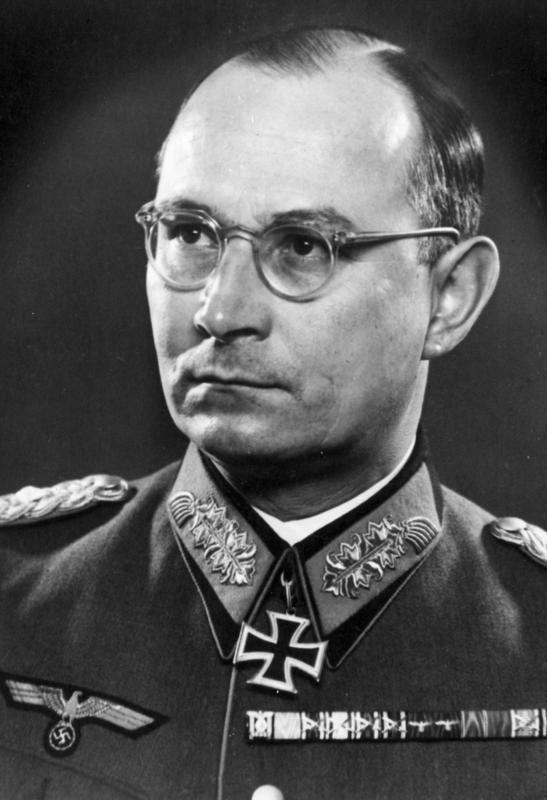
Operation Valkyrie, 69th Year Anniversary!

http://upload.wikimedia.org/wikipedia/commons/a/ae/Bundesarchiv_Bild_146-1972-025-12%2C_Zerst%C3%B6rte_Lagerbaracke_nach_dem_20._Juli_1944.jpg


File:Bundesarchiv Bild 146-1976-130-53, Henning v. Tresckow.jpg

File:Bundesarchiv Bild 146-1981-072-61, Friedrich Olbricht.jpg

Operation Valkyrie was a famous failed assassination attempt to claim Adolf Hitler's life. On July 20th, 1944, Colonel Claus Schenk Graf von Stauffenberg, Major General Henning von Trascow, and Friedrich Olbricht attempted to take full control of all German cities,  disarm he SS and arrest and contain all major Nazi leaders such as Himmler, Goebbels, and Speer once Hitler was assassinated by the explosion of a bomb. Although the assassination attempt was a major fail, Stauffenberg, Trascow and Olbricht did not give up their lives in vain.

Here are links for further research:
1. Jewish Virtual Library:  http://www.jewishvirtuallibrary.org/jsource/Holocaust/julyplot.html
2. Yad Vashem: http://www.yadvashem.org/
3. The United States Holocaust Memorial Museum: http://www.ushmm.org


Friday, July 12, 2013

Father Pierre Marie-Benoît

Hero of the Day: Holocaust rescuer, Pierre Marie-Benoit.

Father Pierre Marie-Benoît was a humanitarian who helped arrange hiding places and smuggle Jews into Switzerland and Spain. Father Benoît had connections with the Jewish underground and several other religious organizations who helped print false documentation for Jewish individuals and families. In November of 1942, Benoît convinced the Italian commissioner of Jewish affairs, Guido Lospinoso, to not act against the 30,000  Jewish individuals and families who lived in Nice and the surrounding areas.

On April 26th, 1966, Yad Vashem recognized Father Pierre Marie-Benoît as Rightous Among the Nations.

Links for further research:

Sunday, July 7, 2013

Edelweiss Pirates

The Edelweißpiraten..."Edelweiss Pirates".  Old enough to skip out of Hitler Youth and young enough to avoid military conscription, this group of Western German kids sang anti-Nazi songs, assisted military deserters, and collected pamphlets dropped by the Allies. 
The Edelweiss Pirates were a small, loosely-organized group of German youth to old for the Hitler Youth and still young enough to avoid forced conscription into the military. The movement originated in Western Germany in response to the strict regimentation of the Hitler Youth and they sang anti-Nazi songs, assisted military deserters, and collected pamphlets dropped by the Allies. This was their popular slogan: " Eternal War on the Hitler Youth".  This was a popular song that a sub group sang: 
Des Hitlers Zwang, der macht uns klein,Hitler's dictates make us small,
noch liegen wir in Ketten.we're yet bound in chains.
Doch einmal werden wir wieder frei,But one day we'll again walk tall,
wir werden die Ketten schon brechen.no chain can us restrain.
Denn unsere Fäuste, die sind hart,For hard are our fists,
ja--und die Messer sitzen los,Yes! And knives at our wrists,
für die Freiheit der Jugend,for youth to be free,
kämpfen Navajos.Navajos lay siege.
Here are some links for further research: 

1. https://www.ushmm.org/wlc/en/media_oi.php?ModuleId=0&MediaId=1237

Note: The following links is an oral interview with a member of the Edelweiss Pirates.