Tuesday, January 24, 2017

Ravensbrück Rabbits

On July 22nd 1942, seventy-five women were called to the Ravensbrück Appellplatz. These women had just arrived from Lublin, all young and fit. The women were inspected by Ravenbrück doctors, Rolf Rosenthal, Gerhard Schiedlausky and Herta Oberheuser, along with Karl Gerbhardt (Himmler's top surgeon) and his assistant, Fritz Fischer. Ernst Grawitz, head of the German Red Cross and an SS physician was also present for parts of the experiments.

Four days later, the group of seventy-five Lublin women were called to the Revier. They were once again inspected by the same group of doctors, eventually selecting only ten for further inspection. From the group of ten, only six were selected for the first round of experiments.

About four days later, the six women who were selected were prepared for experimentation. They were bathed, shaven, given beds and put under anesthetic. In the following hours, the women woke up with hallucinations. Their legs were wrapped in plaster and labelled.

In the following days, the six women were locked into the Revier while their legs swelled and the plaster cut into the wound. Flies were swarming around the rotting flesh while the women drifted in and out of consciousness.  Only three weeks later was the plaster and their bed sheets changed. At the same time, nine new Rabbits were selected and given surgery . By this point, the first round of experiments had proved inconclusive.

In the second round of experiments, it was believed that the tests turned up inconclusive because not enough was done to mimic a battle wound. Therefore, wooden splinters and glass were inserted into the Rabbit's wounds. Larger amounts of bacteria were also used so the infection could spread further. Each new wound was treated with a series of different drugs, sulphonamide drugs or nothing at all.

Although this round of tests proved to also be inconclusive, Ernst Grawitz thought that the injuries of the patients and the drugs used weren't enough. Grawitz was advocating for the next group of women to be shot in the leg.

On September 20th, several other Lublin women were called to the Revier. These women were not shot in the leg, however, they were injected with larger amounts of bacteria and more foreign objects (ex: glass, wood). After several days of leaving the current wounds rotting and undressed, the Rabbits were taken to the operating theater. Over the coarse of the following five days, each Rabbit was injected with several more rounds of various types of bacteria. By that point, the remaining Rabbits experienced excruciating pain in their legs and a terrible thirst.

After the final round of injections, the Ravenbrück Rabbits began to heal or die.

Alfreda Prus, a former student at the University of Zamość was given the label K1. Many suspected Alfreda had gangrene. For days she hiccuped and swore she was going to die. On her final day of life, a new incision was made in her leg. When she returned to her bed, she bled profusely.  She was taken away on a stretcher, only to be heard screaming moments later.

Weronika Kraska was believed to be injected with tetanus. Complaining of a stiff neck, she was forced to drink water due to a locked jaw. While speaking of her two children, Weronika gave out a scream. As her condition worsened, Gerda Quernheim (a prisoner who worked alongside the camp doctors) injects her with a needle.

By the time the first four groups were healing from their wounds, another new group of women were called up to the Revier. On October 7th, 1942, the new group of Rabbits were bathed, inspected by a group of doctors  and injected with various types of bacteria and foreign objects. The women awoke, several days later, with hallucinations, hiccups and stiff necks. A couple days after their injections,  nine out of the original twelve were left.

Alfreda and Kazimiera Kurowska died from an extensive gangrene infection. The bacteria quantities were so large that their bodies couldn't put up a defense. Kazimiera's right leg was completely destroyed. Once the infection began to spread to the right side of her body, she was given a massive dose of morphine. Another Rabbit, Weronika Kraska was injected with tetanus, which killed her.

After the sulphonamide experiments, the surviving Rabbits were left to fend for themselves. The women were left in beds that were grey and sticky, while flies and maggots fed on the puss oozing from their wounds.

In the end, each round of the sulphonamide experiments proved to be inconclusive. Heinrich Himmler, by the end of October, had moved on to new interests.

Himmler believed that Karl Gerbhardt and Ludwig Stumpfegger (Adolf Hitler's future personal surgeon) should investigate the mending of broken bones. On November 2nd, a new group of Rabbits were called to the Revier. The incoming women were subjected to various types of operations: bone grafts, bone splinters, bone breaking and operations on muscles.

In the name of curiousity, dozens of Polish women and eventually women of various other nationalities were mutilated and abandoned. In 1946, four of the Ravensbrück Rabbits were able to give evidence at the Nuremburg Doctor's Trial.


Clandestine photograph of a Polish political prisoner and medical experimentation victim in the Ravensbrueck concentration camp.

Pictured is Maria Kusmierczuk. 
Maria Kusmierczuk showing her mutilated leg. On October 7th, 1942, Maria was infected with tetanus bacteria as a part of the Ravensbrück sulfanilamide experiments. Her wound did not heal, leaving the bone exposed and her unable to walk. 

Clandestine photograph of a Polish political prisoner and medical experimentation victim in the Ravensbrueck concentration camp.

Pictured is Bogumila Babinska (Jasiuk).

Bogumila Babinska survived two operations on the muscles of her thigh. The operations were performed in November and December of 1942. In 1943, another operation was performed on her shin bone. Bogumila was one of the Ravensbrück Rabbits to write secret messages in urine.  She passed in 1980. 

Clandestine photograph of a Polish political prisoner and medical experimentation victim in the Ravensbrueck concentration camp.

Pictured is Barbara Pietrzyk.  Her prisoner number is visible on the sleeve of her coat.  Maria Kusmierczuk is standing in the back.

Barbara Pietrzyk survived bone operations on each leg at the age of 16. Unfortunately, Barbara passed in 1949 at the age of 21. A factor in the cause of her death being the operations she forcibly underwent  at Ravensbrück. 


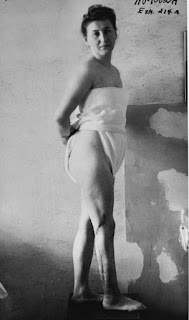
Jadwiga Dzido. 
 
A war crimes investigation photo of Wladislava Karolewska, a survivor from Ravensbrueck, who was subjected to medical experiments with sulphonamide drugs in 1942. 

The experiments were conducted by Dr. Fritz Fischer, Prof. Karl Gebhardt, Dr. Stumpfegger and Ravensbrueck camp doctor, Herta Oberheuser.  This photograph was entered as evidence for the prosecution at the Medical Trial in Nuremberg.

The disfiguring scars on the woman's right leg resulted from incisions made by medical personnel that were purposely infected with bacteria, dirt and slivers of glass, in order to simulate the combat wounds of German soldiers fighting in the war.  The inflamed area was then treated with sulphonamide drugs.  Many of the prisoners subjected to these treatments died from their wounds.
 
Wladislava Karolewska


Links for further research: 
1. Information about Maria Kusmierczuk:

2. Information pertaining to Bogumila Babinska: 

3. Further information about Barbara Pietrzyk: 
 
4. Further reading about Jadwiga Dzido:
 
5. More information about Wladislava Karolewska:

Sunday, January 1, 2017

Welcome to my Holocaust History Blog!

In June of 2013, I posted my first article or post on this blog. It was then that I decided to dedicate my life to studying the Holocaust.

Several years before my first post, the Hübener group is what started my initial study. After reading a fictional depiction of Helmuth Hübener's life, "The Boy Who Dared" by Susan Campbell Bartoletti,  I spent my entire summer taking notes from books that I read from a local library. Eventually, I began to build my own library of Holocaust memoirs and historical texts which provided me with first-hand accounts by survivors and the historical perspective of scholars and historians. In 2013, I decided that it was important to continue gaining my knowledge of the Holocaust and to share it. Therefore, I started writing on this blog whenever I found the time in my busy schedule and I talked about the Holocaust in countless projects throughout high school. There was a time that I was actually organizing an assembly with a teacher who's mother immigrated to the USA after experiencing Kristallnacht.

Now, I have recently rediscovered the things in my life that I am passionate about. Five years after my first blog post, writing about the events and individuals of the Holocaust is what I am passionate about. I find it fulfilling to research the lives of individuals who are remembered little or if at all. I find it fulfilling to provide them with a voice and to recognize them as human beings and not as a part of a statistic. I feel accomplished knowing that I work hard on all of my articles. Most of all, it comforts me to know that I do not stand alone in my study of the Holocaust and events of injustice throughout this world's history. I feel comforted knowing that there are others hard at work in giving victims a voice, in providing factual information about places and events and in helping the future and present generations to never forget.

Through my rediscovery and evaluation of my passions, I noticed that I really neglected this blog. It being the New Year, I decided that I want to challenge myself to study, learn and share more. Therefore, I am hoping to post a new article each week. The funny thing is, I have absolutely no problem finding topics, it's the discipline and time that needs some work.

I hope everyone has had a wonderful holiday season and they have an eventful year to look forward too. Wishing everyone luck in accomplishing their goals!

- Danielle Hellmuth. 

Friday, December 30, 2016

Livia Bitton-Jackson


Livia Bitton-Jackson (formerly Elli L. Friedmann) is a Holocaust survivor from Czechoslovakia and the author of the Holocaust memoir, "I Have Lived a Thousand Years". Jackson was born in Chamorin, Czechoslovakia (formerly Samorin, Slovakia) in 1931. She lived the normal life of a thirteen year old up until the Nazi invasion of Hungary on March 19th, 1944. She was imprisoned in the Nagymagyar ghetto, Auschwitz, Plaszow, and Augsburg. At the end of the war, she was eventually liberated from the Death Train.

In 1951, Livia Bitton-Jackson immigrated to the United States with her mother and surviving brothers.  The memoir, "I Have Lived a Thousand Years" is a great text for adolescents. It provides a teenager's insight into the Holocaust. She is also the author of two other memoirs, "My Bridges of Hope" and " Hello, America" which provide insight into her life after liberation and the struggles of establishing a new life in New York City.


Image result for Livia Bitton-Jackson

Image result for Livia Bitton-Jackson

Links for further research: 


Polina Gelman

Back in September of 2013, I wrote an article about the Nachthexen. A group of Russian female military aviators who flew harassment bombings against the German military. The group of aviator women also flew precision bombing missions. Their flight missions began in 1942 and continued until the end of the war.

One of the notable members of the "Night Witches" was Polina Gelman. I recently ran across her story and decided to share.

Polina was born in Berdichev, Ukraine in 1919. As an adolescent, she took flight lessons. When the German troops were nearing closer to Moscow, in October of 1941, Polina volunteered for the Red Army. She believed it was not only her duty as a Soviet citizen but as a Jewish woman to volunteer and stand up to Adolf Hitler.

On May 27th, 1942, she became a navigator. Her job was extremely important because she led the way for her fellow aviator pilots. The following pilots would bomb fuel and ammunition depots along with targeting bridges and German vehicles. Polina's crew brought supplies to the Red Army while also knocking out German searchlights that searched for Soviet Planes.

After several other notable roles in her regiment and a career as a military officer, Polina passed in November of 2005.

Polina Gelman

Here is a link for further research: 

Note: Thank you to Yad Vashem for helping provide content for this article. 

Sunday, November 13, 2016

Heinrich Himmler and His Obsession with Medical Experimentation

Heinrich Himmler was the Reichsführer of the Nazi Party's SS. Being the second most powerful within  Nazi Germany, Himmler was the Nazi official who conceived and implemented the Final Solution.

Heinrich Himmler also had a reputation for ardent beliefs in "racial consciousness," however, Himmler was also a man obsessed by medical experiments which he believed could reverse the damage of warfare injuries and for multiple other "justifiable" reasons.  Quite a few of these experiments involved the women prisoners of Ravensbrück.

1. The Preservation of Slave Labour

In the Spring of 1942, Heinrich Himmler implemented new harsh directives at Ravensbrück. He wished to extend the use of concentration camp slave labour by increasing the hours of work, making a deal with Siemens (German electrical company) to exploit Ravensbrück women. However, it did not stop there and Ravensbrück women were further exploited through the establishment of brothels in male camps such as Dachau, Mauthausen, Buchenwald and Flossenbürg where the women were to be used as prostitutes.

The use of Ravensbrück women in brothels established in male camps was connected to an idea Himmler had for "reinvigorating" male slave labourers after a visit to Mauthausen where he witnessed emaciated prisoners dying. Therefore, through sex, male prisoners would be encouraged to work better with coupons to visit the brothels.

2. Sulphonamide Experiments

May 27th, 1942, Reinhard Heydrich, the SS-Obergruppenführer and proclaimed protector of Bohemia and Moravia, was assassinated by Jozef Gabcik and Jan Kubis, members of the Czech resistance. While the security police where on a blood hunt, particularly against the village of Lidice, Karl Gebhardt (Himmler's top surgeon and the surgeon who attempted to heal Heydrich) was receiving pressure from Adolf Hitler.

For months, German forces were experiencing casualties due to infection of warfare injuries. Most common, being gas gangrene, when shrapnel and debris pierced wounds. This was similar to Hydrich's wound when Jan Kubis threw the bomb that caused shrapnel, glass, upholstery fibres and wire into his spleen. The race to find a "miracle drug" was raging on, especially since the Allies were diminishing casualties with a formulated type of penicillin, and Himmler stepped in, offering healthy concentration camp prisoners.

The first group chosen for human experimentation were male prisoners from Sachsenhausen. The male prisoner's legs were cut open, and different quantities of bacteria were inserted into their legs. A variation of sulphonamide was given to each prisoner, however, the results proved inconclusive.

                                                               
                                                                  Maria Kusmierczuk


                                                                      Jadwiga Dzido


Vladislava Karolewska

Ravenbrück women, also known as "Rabbits," who survived. If you look at their legs, you can see the mutilation that was caused due to Himmler's experiments. 


3. "Human Warmth" Experiments

By October 1942, Himmler had grown bored with his sulphonamide experiments. Now, he was infatuated with the idea that sailors and airmen who were exposed to freezing seas were revived by human warmth. He urged Sigmund Rascher to use Ravensbrück prostitutes, having been given four, for his experimental use.

Eight male prisoners were submerged in near-freezing water inside a large tank and left inside until found unconscious. The men were then placed in a bed between two naked Ravensbrück women. The women were to nestle as close as possible under the cover of a blanket.

The men quickly revived, however this experiment wasn't anymore effective than any other form of re-warming. One of the male prisoners subjected to experimentation had a cerebral haemorrhage and died.

4. The Breaking of Bones

Ludwig Stumpfegger, in November, 1942, proposed the experiment of breaking bones to see if they would grow back together. The first new guinea pig was Basia Pietryzyk, a sixteen-year-old Polish dancer. Stumpfegger chiselled bone out of her right and left tibias. Over the course of a few weeks, three different types of operations occurred: bone grafts, bone splinters and bone-breaking. Bone breaking involved the shin bones being smashed by hammers. Other times, the whole fibula or tibia was taken out.

5. Operation on Muscles

First, the muscle was exercised. With each operation, larger parts of the muscle were taken out.

6. Removal of Whole Limbs

In November 1942, bacterial experiments were still being carried out, but a new form of experimentation emerged. Women called the 'lunatics' were subjected to amputation of whole limbs. Victims were murdered on the operating table.

Himmler ordered this experiment of limbs because he wanted Stumpfegger to copy the technique of a Russian doctor who transplanted limbs.

This is part one of a group of articles about medical experiments at Ravensbrück. My next article will be about the Ravensbrück Rabbits, which is mentioned briefly above. My final article for this group will be about the role of the German Red Cross in providing aid to concentration and extermination camp prisoners.

Thank you and I have attached links for further research:
1. http://www.jewishvirtuallibrary.org/jsource/Holocaust/sulfaexp.html
2. http://www.jewishvirtuallibrary.org/jsource/Holocaust/Karolewska.html
3. http://www.jewishvirtuallibrary.org/jsource/Holocaust/bonexp.html
4. http://www.jewishvirtuallibrary.org/jsource/Holocaust/nazi_experiments.html


Friday, June 24, 2016

Olga Benario-Prestes


Olga Benario-Prestes was a prominent German-Brazilian communist militant. Benario-Prestes was born on February 12th, 1908 to prominent middle-class parents, however, by age 14 (1922) she chose to run away from home and join the communist cause.

After leaving Germany in 1929 to train with Stalin's elite, Olga was then sent by Stalin to Brazil to organize an overthrow against President Getulio Vargas. After being chosen for the Comintern (Communist International organization), in November 1936, Benario-Prestes was handed over to the Gestapo. Her arrest was consequence of a British intelligence tip-off.

Olga Benario-Prestes was then imprisoned at Ravensbrück until 1942 when she was sent with the first few groups of Ravensbrück prisoners to be gassed at Bernburg. While imprisoned at Ravensbrück, Olga was still a key player. For a time she was a Blockova (a female version of a Kapo, which was a prisoner functionary) where she aided those around her. 

Olga Benario-Prestes, photo via Wikimedia Commons


I came across Olga's story while reading Ravensbrück by Sarah Helm, which I highly recommend. I have attached a link for further research. Thank you!


Monday, May 16, 2016

Hitler's War on "Asocials"

In 1938, a program called 'Aktion Arbeitsscheu Reich' (Action Against the Work-shy) was launched which thus created a new stage in the Nazi purge of not only Germany's Jews, Gypsies and mentally or physically disabled individuals but of Germany's underclass.

The primary targets of this program were those "considered social outcasts, largely unnoticed by the outside world, and unreported within Germany, more than 20,000 so-called 'asocials'--'vagabonds, prostitutes, work-shy, beggars and thieves'--were rounded up and earmarked for concentration camps." (Pg #16 of Ravensbrück by Sarah Helm) 


While gathering evidence for this article, I was gobsmacked to discover that there is little to no real information about this program or it's victims. Sarah Helm's Ravensbrück is the only real source that provides any insight that I have found. 


This is partly due to this stigma attached to the "asocials" imprisonment, and therefore, fear of speaking out. Sarah Helm describes it perfectly, "Although we learn alot about what the political prisoners thought of asocials, we learn nothing of what the asocials thought of them. Unlike the political women, they left no memoirs. Speaking out after the war would mean revealing the reason for imprisonment in the first place, and incurring more shame...The German associations set up after the war to help concentration camp survivors were dominated by political prisoners. And whether they were based in the communist East or in the West, these bodies saw no reason to help 'asocial' survivors. Such prisoners had not been arrested as 'fighters' against the fascists, so whatever their suffering none of them qualified for financial or any other kind of help. Nor were the western Allies interested in their fate. Although thousands of asocials died at Ravensbrück, not a single black-or-green triangle survivor was called upon to give evidence for the Hamburg War Crimes trials, or any later trials. As a result these women simply disappeared: the red-light districts they came from had been flattened by Allied bombs, so nobody knew where they went. For many decades, Holocaust researchers also considered the asocials' stories irrelevant; they barely rate mention in camp histories. Finding survivors amongst this group was doubly hard because they formed no associations, nor veterans' groups." (pg #90 of Ravensbrück by Sarah Helm) 


My heart weeps for women, such as, Anna Solzer, Ottile Gorres, Elisabeth Fassbender, Else Krug, Agnes Petry and countless other women who perished in Ravensbrück and who's memory is dismal and faint. At the same time, I am angry that victims of the same Holocaust as Anne Frank or Gerda Weissmann Klein are stigmatized and deemed irrelevant. 


The women of Ravensbrück, regardless of their imprisonment, and all the victims of Hitler's Holocaust and of any violation of human rights are important. Let's start to look at and value human lives simply as human lives. Not by the measure of how they made a living to survive or how the world views/ viewed them. 


For more research I highly recommend you read: 

1. Ravensbrück by Sarah Helm
   I have attached a link that allows you to read up to the end of the first chapter:
https://blog.longreads.com/2015/07/14/the-missing-history-of-ravensbruck-the-nazi-concentration-camp-for-women/